|

|
|
|
About us |
The Clinic |
News |
Reports |
Donations |
Shop |
|
|
|
|
|
|
|
|
|
|
|
|
|
|
|
|
|
|
|
|
|
|
Welcome |
Seiten
auf
deutsch
|
|
|
|
About
us |
Eyes For East Africa is the website name of the Kwale District
Eye Centre Charity that operates in a poor rural district on the
Kenya Coast. The Centre was founded 1993 by UK trained ophthalmologist Dr Helen Roberts, now resident in Kenya.
There are many cases of child and youth blindness, mainly preventable
and symptomatic of poor diet and parental ignorance. The most common
cause of blindness is cataract, for which treatment is by phacoemulsification
surgery and the insertion of intraocular lenses.
Since 1993, 70,000 new patients have been registered at the Centre. This figure does not include all the patients we see, as many need to return for ongoing follow up and care. Many thousands of patients, who have walked through our doors, are still receiving support and eye care services both at base, in schools and in the field.
In addition to the patients seen at the clinic, over 275,000 patients have been seen in the field.
Over 27,100 eye operations have been performed, of which 22,851 were sight-restoring cataract operations.
In remote parts of Kenya, where the centre can only provide short-term help, over 23,219 patients have been treated. The half-year report for January to June 2012 is now available, please click here to
view it and to view reports from earlier years.
No patients
are refused treatment. Donations are required, particularly to
allow poor patients to undergo surgical procedures.
If you would like to make a donation online via PayPal please click the Donate button to the right, for other ways to donate please see below or go to the Donations page. |
|
 |
The clinic is an official training centre for the University of Nairobi, Department of Ophthalmology. Click here to visit the University's official web site. A short video of work at the Kwale District Eye Centre is available on YouTube. |
|
Making Donations and the Eye Give Shop |
You can make a donation on-line or
by sending us a cheque.
The 'Eye Give' shop allows you to tell us how you want your
donation to be used. You have a choice of eye care items including £5 for a pair of reading glasses, £60 for a cataract operation, £360 to pay a trained nurse’s salary for 1 month and more. You
can make an Eye Give donation on behalf of others, which is ideal for
birthdays, Christmas, anniversaries and other special occasions.
Please go to the Donations page and the Shop page
for further information. |
|

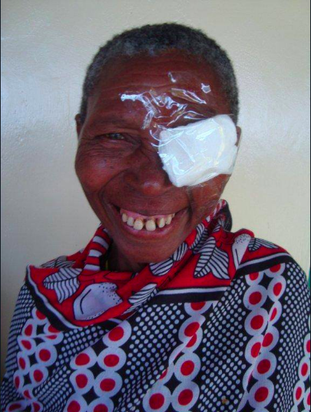
Above: Some of the people who have benefited from a donation made on your behalf…..Thank
you |
Training
This is perhaps the most important thing we do long term, both clinically and in the community. |
Training of Medics:
KDEC is approved by the Medical Practitioner and Dentist board as a training centre for specialist recognition in Ophthalmology. It has been training Ophthalmology students from the University of Nairobi. Ophthalmic registrars do a practical attachment in both clinical work and surgery. KDEC has trained 6 ophthalmologists so far.
Kenya Medical Training college (KMTC) sends Ophthalmic Clinical Officers / Cataract surgeons to KDEC for their practical attachment. 8 students have been trained to date. Training of nurses in ophthalmic skills upgrading and Training for Facilitators for this is planned for June 2012 in Kwale.
In cooperation with other main eye-care service providers and general medical institutions in the coast region, we hold regular caucus meetings and Continuous Medical Education for ophthalmologists and clinical officers in post. |
|

Surgical teaching is a very important part of our work.
In the photograph shown above Professor Schuette visiting from Germany teaches our clinical officer squint surgery |
Training of Teachers and community Students:
- Kenya Institute of Special Education (KISE) and Kenyatta University’s special needs programme has recognised the services offered by KDEC’s low vision programme and we receive students on attachment.
- University students in Community development studies spend a 3-month practical attachment to our Community Based Programme.
Training of the community:
- Government Employees – Rural Health Workers, Social Development Assistants and Teachers in primary schools.
- Community Own Resource Persons - Village Health Committees, Traditional Birth Attendants, witch doctors and herbalists, community health workers and parents of visually impaired
|
Research |
Main fields
- Community
- Cataract outcome
- Glaucoma screening and management
- HIV-related diseases and treatment
Publications:
- Lewallen S, Roberts H, Hall A, Onyange R, Temba M, Banzi J, Courtright P. Increasing cataract surgery to meet Vision 2020 targets; experience from two rural programmes in east Africa. Br J Ophthalmol. 2005 Oct;89(10):1237-40.
- Briesen S, Roberts H. The challenge of follow-up visits after cataract surgery in the developing world.
Clin Experiment Ophthalmol. 2012 Mar;40(2):119-20.
- Briesen S, Ng EY, Roberts H. Validity of first post-operative day automated refraction following dense cataract extraction.
Clin Exp Optom. 2011 Mar;94(2):187-92.
- Briesen S, Roberts H, Lewallen S. The importance of biometry to cataract outcomes in a surgical unit in Africa.
Ophthalmic Epidemiol. 2010 Aug;17(4):196-202.
- Briesen S, Geneau R, Roberts H, Opiyo J, Courtright P. Understanding why patients with cataract refuse free surgery: the influence of rumours in Kenya. Trop Med Int Health. 2010 May;15(5):534-9.
- Briesen S, Roberts H, Ilako D, Karimurio J, Courtright P. Are blind people more likely to accept free cataract surgery? A study of vision-related quality of life and visual acuity in Kenya.
Ophthalmic Epidemiol. 2010 Jan-Feb;17(1):41-9.
- Briesen S, Schulze Schwering M, Roberts H, Kollmann M, Stachs O, Behrend D, Schäfer S, Guthoff R. Minimal cross-infection risk through Icare rebound tonometer probes: a useful tool for IOP-screenings in developing countries. Eye (Lond). 2010 Jul;24(7):1279-83.
- Briesen S, Roberts H, Karimurio J, Kollmann M. [Biometry in cataract camps. Experiences from north Kenya].
Ophthalmologe. 2010 Apr;107(4):354-8. German.
- Briesen S, Roberts H. Repair of Descemet’s membrane detachment with air. East African J Ophth. 2008
|
Did you know? |
- Worldwide one person goes blind every five seconds.
- One child goes blind every minute.
- Of the 45 million people who are completely blind,
90% live in the developing world.
- In Kenya the rate of blindness is 10 times that of
the western world.
- One person in every hundred is totally blind, but
80% of this is preventable, over half is due to cataract.
- The ratio of ophthalmologists to the population in
Kenya is in the region of 1 : 1 million and they are concentrated in
the cities. In UK the ratio is around 1 : 70,000.
|
|

Above: the new sign that stands
by the main road 500 metres from the Eye Centre. |
Links to other sites
Click here for a page of links to web sites
that provide useful information for eye patients and links to some of
our supporters who specialise in helping those with eye problems.
For further information about the work of the Kwale District Eye Centre
please browse the site.
Hier
klicken zum Download einens Artikels von Dr. Stefan Vogel über
die Arbeit des Kwale District Eye Centers (260 KB)
|
|
|
| |
About us |
The Clinic |
News |
Reports |
Donations |
Shop |
|
|
|
|
|
|
|
|
|
|
|
|
|
|
|
|
|
|
|
|
|
|
|
|
|
|